
These are mine.
At 46, I've gotten pretty clear on what I'm willing to compromise on. My health, how I spend my time, and how I show up at home aren't things I'm willing to keep letting slide.
I spent enough years being dependable for everybody else while making excuses for myself. I trained when I felt motivated. I put things off. I could be in the room with my family and still have most of my attention somewhere else. I'm not interested in going back to that version of me.
The first five habits in this guide are my standards. The next six are how I put the fitness work into practice. They don't all carry the same weight. Drinking water and being present with your kids aren't equal responsibilities. But both deserve something more specific than good intentions.
Do I nail all of these every single day? Of course not. When I fall short, I own it and get my shit together. I'm not going to lower my standards just because I didn't live up to them yesterday.
You might have different standards. Good. You should know what matters enough that you're unwilling to keep compromising on it. These are mine. Use the examples to figure out what they look like in your life.
Read through once, or jump to the habit you need most. Pick one specific thing to put into practice today. You don't need eleven new assignments tonight. You need to stop leaving everything at 'I should probably do that.'
My five standards.
What I refuse to keep letting slide. Your version needs to fit your life.
Get up and get after it.
I'm not starting my day already behind. I get my ass out of bed, take control of my morning, and get something productive done before everybody else needs something from me.
And I'm sure as hell not hitting snooze four times and then wondering where my morning went. But getting up early isn't the whole point. Having some say in how the day starts is.
If you set an alarm you have no intention of getting up for, start there. Pick a time that fits your work, your sleep, and what actually needs to happen. Get your clothes, equipment, or first task ready the night before. Don't make your half-awake self figure the whole thing out.
A dad leaving for an early shift and a dad getting kids ready for school won't have the same morning. Neither needs a two-hour routine. A workout, a few minutes planning the day, or getting breakfast and lunch handled can all be useful starts. Choose yours before the alarm goes off.
Give yourself a first move.
'I'll have a better morning' doesn't tell you what to do. 'When I get up, the phone stays on the charger while I get dressed and start my workout' does. If you've been up with a baby, the plan may need changing. Taking care of yourself includes making room for sleep. There isn't a prize for setting the earliest alarm.
Move your ass.
I train. I walk. I pay attention to what I eat. I spent enough years neglecting my health. Not interested in doing that again.
I don't need two hours in the gym or some elaborate fitness routine. I've got 20 minutes, and I know what to do with them. That doesn't mean every part of taking care of myself fits inside those 20 minutes. Food, walking, and recovery still matter.
You can want to lose the gut, build muscle, feel better in your clothes, or stop getting winded doing ordinary things. Pick a reason that means something to you. Being able to join your kid instead of watching from the sidelines is a perfectly good reason to start.
This standard means my health gets a place in my life. It doesn't mean I train hard every day, ignore pain, or make the entire house live around my workouts. Planned recovery belongs in a training routine too.
Give it an actual place in the week.
'After work' might be the busiest part of your day. If that's when you want to be with your family, look for a different window: before work, during a workable lunch break, on a work-from-home day, or after bedtime. It can vary by day. Decide where it fits instead of hoping a spare hour turns up. Habit 6 covers what to do with that time.
Create more than you consume.
I can spend an hour watching other people build shit, accomplish things, and live their lives... or I can actually do something with mine.
I still scroll, watch stupid videos, and waste time like everybody else. But I'm a hell of a lot more conscious of how much of my day I'm giving away.
Look at what happens when you finally get a little time to yourself. Do you work on something you care about, or reach for the phone and lose the whole window? Sometimes the answer is an honest break. Sometimes you've watched fourteen videos about doing the exact thing you keep putting off.
Creating doesn't mean starting a business or becoming a content creator. Cook something. Work on the project. Practice the guitar. Write, build, repair, or make something. Research can help, but it needs to lead somewhere.
Give the time back to something you want to do.
Pick one repeat scrolling window, then decide what you'll do with part of it. Put the phone out of reach, set a limit you'll respect, or remove the app you keep opening without thinking. You can still watch the game and enjoy dumb videos. The point is to choose, instead of discovering where the time went afterward.
Handle your shit.
If something needs done, I do it. Dishes, laundry, fixing shit, whatever. I'm not 'helping' my wife around the house. It's my fucking house too.
I don't need a chore chart or a congratulations for being a functioning adult. I need to notice what needs doing and take responsibility for it.
That doesn't mean I have to do every job myself. It means we agree on who owns what, and I follow through on my part. If somebody else has to notice, remind me, explain it again, and check whether I finished, I haven't taken much off their plate.
It's easy to stay busy with the jobs you like. You can spend Saturday getting the garage perfect while the laundry everyone needs is still sitting in a pile. The job that needs doing might be less interesting than the project you feel like doing.
Finish the whole job.
Laundry doesn't end when the washer starts. Kitchen cleanup doesn't end when the plates disappear into the sink. Owning the job means knowing what finished looks like and handling the parts that get it there. Talk about expectations when you need to. You don't have to guess what everyone wants, but you shouldn't need a fresh invitation to do your share every time.
Go first.
I don't wait for my wife to initiate affection or my kid to ask for attention. I make the effort. I put the phone down. I make time for the people who matter most to me.
And I'm not going to pretend that simply being in the same room counts as quality time. You can be home all evening and still spend most of it looking at a screen or thinking about work.
Going first can be small. Ask your wife how her day went and actually listen. Invite your kid to do something. Sit beside them and get interested in what they're interested in. Initiate affection your partner welcomes without making it a transaction.
You don't have to turn every evening into a family event. Ordinary moments count when you're actually engaged. A shared show can be time together. So can a drive, a walk, or making dinner. Pay attention to whether you're connecting or just occupying the same space.
Let them have some say.
If your kid invites you into their game, you don't need to immediately fix the rules. If your partner starts talking, you don't need to turn every sentence into a problem-solving exercise. Ask what they'd enjoy or what they need from you. Sometimes the useful thing is simply putting the phone away and being there without running the whole activity.
The fitness work.
How I approach training, food, and following through. Simple things with a specific place in the week.
Train with a plan.
I train shorter, but I train harder. Know what you're doing, give the working sets real effort, and record the work.
If you have 20 minutes, spending the first eight looking for a workout is a pretty expensive warm-up. Have the exercises, equipment, and basic structure figured out before you begin.
A plan should fit your ability, equipment, and available time. You don't need my garage gym. You do need a routine you can repeat long enough to learn the movements and see what changes. Switching workouts every time makes that harder to judge.
Short workouts aren't permission to coast. Once you're warmed up and into your working sets, the last few reps should take effort. Choose a weight or exercise version that challenges you while you stay in control. On most working sets, finish feeling like you could manage only a couple more clean reps, not another twenty. If you're new to the movement, learn it before pushing the effort.
Harder doesn't mean rushing, throwing weights around, or turning every set into a fight for survival. You don't need to hit failure on every set. Take the rest you need to do the next set well. I want useful work in the time I've got, not a longer session full of easy reps and phone breaks.
Record the work as you go: exercise, weight, reps, and anything useful about how it felt. If you're using a timed format, track it the same way each time. Compare like with like. A different exercise, shorter range of motion, or completely different session isn't the same test.
Have an answer when the usual time disappears.
A backup can be a different time, a shorter planned session, or suitable movement when training isn't workable. Choose it beforehand. A fallback helps you keep participating; it isn't automatically equivalent to your full workout. Follow the recovery days in your plan, and don't push through pain to prove you followed a standard.
Pay attention to what you eat.
Have a few meals figured out. Know how much you're eating instead of assuming it's fine because it's homemade.
You don't need to turn dinner into an entirely separate event from what your family eats. Start by understanding your own meals and portions. 'We eat pretty healthy' can be true while still leaving a lot unanswered about what you're actually eating.
Look at a normal day, including the things that don't feel like meals: drinks, handfuls while cooking, the kids' leftovers, and the snack after everyone's in bed. Record them honestly if you're tracking. Leaving them out makes the picture less useful.
Have a few breakfasts and lunches you can repeat, and know what's happening for dinner before you're starving. I focus on protein and fiber: a protein source with the meal, plus fruit, vegetables, beans, or whole grains. Protein supports the muscle you're working to build and keep. Protein-rich and fiber-rich foods can also help make meals more filling. You still need to pay attention to portions.
Keep something filling within reach.
If the easiest thing to grab is the bag of chips, that's probably what you'll grab. Keep a few filling, lower-calorie options ready: plain low-fat Greek yogurt with berries, low-fat cottage cheese with fruit, or cut vegetables with a yogurt-based dip. Fruit and lightly seasoned air-popped popcorn are easy fiber options too. Check the portion and toppings; 'healthy' doesn't make calories disappear. Pick a couple you actually like and keep them where you'll see them. This doesn't need to become a second meal-prep job.
Drink your damn water.
Keep it handy and drink it throughout the day. Simple enough.
This doesn't need a motivational speech or a bottle with twelve inspirational deadlines printed down the side. It needs to be easier to remember than it is to forget.
Put water where you spend your day. At your desk, in the car, with your lunch, wherever it makes sense. Fill the bottle when you're already in the kitchen. If it's empty and sitting three rooms away, you've made a simple thing less convenient than it needs to be.
Connect it to something you already do: breakfast, arriving at work, lunch, or getting home. If you have a personal target from your coach or clinician, work it into those routines. Don't copy a stranger's gallon challenge just because he's loud about it.
Make the setup do some of the work.
A bottle you can see is a better reminder than a vague intention. Use one you like, know how much it holds, and refill it at times that fit your day. You don't need to obsess over every sip. You need a setup you'll use consistently enough that water isn't an afterthought.
Get your steps in.
Take a walk. Find reasons to move during the day, especially if work keeps you in a chair.
A workout doesn't tell you how active the rest of your day is. You can train in the morning and spend nearly everything after it sitting at a desk, in the car, and on the couch.
Start by seeing what your days actually look like. If your phone or watch counts steps, look at several ordinary days. Notice the difference between office days, days at home, and weekends. Your old activity level may not match the job and schedule you have now.
Then find movement that fits. Walk during part of lunch, take a short break from the desk, or go around the neighborhood after dinner. Invite your family when that works. Walking can give you some time together as well as movement.
Start from where you are.
I aim for 10,000 to 12,000 steps a day. You don't need to jump straight to my number. Look at your usual daily average, aim for about 2,000 more, and build from there once that's manageable. Averaging 4,000? Start by working toward 6,000. If adding 2,000 is too much right now, take a smaller step and work up. Account for your ability and the movement your job already requires.
Be honest about what you did.
With yourself and whoever's keeping you accountable. They can't help you adjust a plan you're pretending to follow.
'Pretty good week' doesn't tell us much. Neither does 'I sucked.' What did you actually do? What did you miss? What got in the way? That's information you can work with.
If you planned four sessions and did two, say two. If dinner kept turning into grazing because you got home late, say that. If you couldn't stand the workout or it didn't fit your equipment, don't quietly disappear. Bring up the problem while there's still something useful to change.
Accountability doesn't require making your whole life public. A coach, a trusted friend, or a private check-in can be enough to make the work visible. Choose somebody who can listen, ask useful questions, and help you follow through. Your wife doesn't have to become your workout supervisor.
Give enough detail to make the next decision.
Try this: 'I trained Tuesday and Thursday. Monday ran late, and I never picked another time. Next week I'm putting that session on my work-from-home day.' You've reported what happened, found a problem, and proposed an adjustment. No speech about how you're starting a whole new life Monday.
Find something to improve.
Another rep, a better lunch, getting to bed on time. Pick something worth improving without trying to fix everything at once.
You don't have to beat every number every day. Some sessions go better than others. Some days the improvement is following the plan without adding a bunch of extra work because you're feeling impatient.
Look for a specific change that would make the next week better. Maybe your weights and reps show you're ready for a progression. Maybe breakfast is fine, but lunch keeps getting skipped. Maybe the workouts are written down and you're still losing time finding the equipment.
Fix the thing that's getting in the way. Keep the parts that already work. You don't need to replace your whole program because you had one rough session or saw somebody else's results online.
Check whether the change helped.
If you packed lunch three days this week, see whether that made your workdays easier. If you moved a workout to a different time, see whether you actually did it. Improvement can mean better preparation, better execution, or a more workable plan. Increasing everything at once gives you more to manage without telling you which change helped.
When you fall short.
You're going to fall short sometimes. You know that already. Missing yesterday doesn't require lowering the standard today, and it doesn't require punishing yourself either.
Own what happened. If it was one rough day, make the next useful decision. If the same problem keeps coming up, change how you're approaching it. A workout window that disappears every week needs a different arrangement, not another promise to try harder.
A smaller action can help you keep going on a disrupted day. It doesn't magically equal the full plan. Keep that distinction honest, then return to the work instead of making the fallback your permanent routine.
I have no intention of going back to the version of me who kept making excuses for himself. That doesn't mean every day looks impressive. It means I keep taking responsibility for what I do next.
Keep the standard. Adjust how you meet it. Own it when you miss.
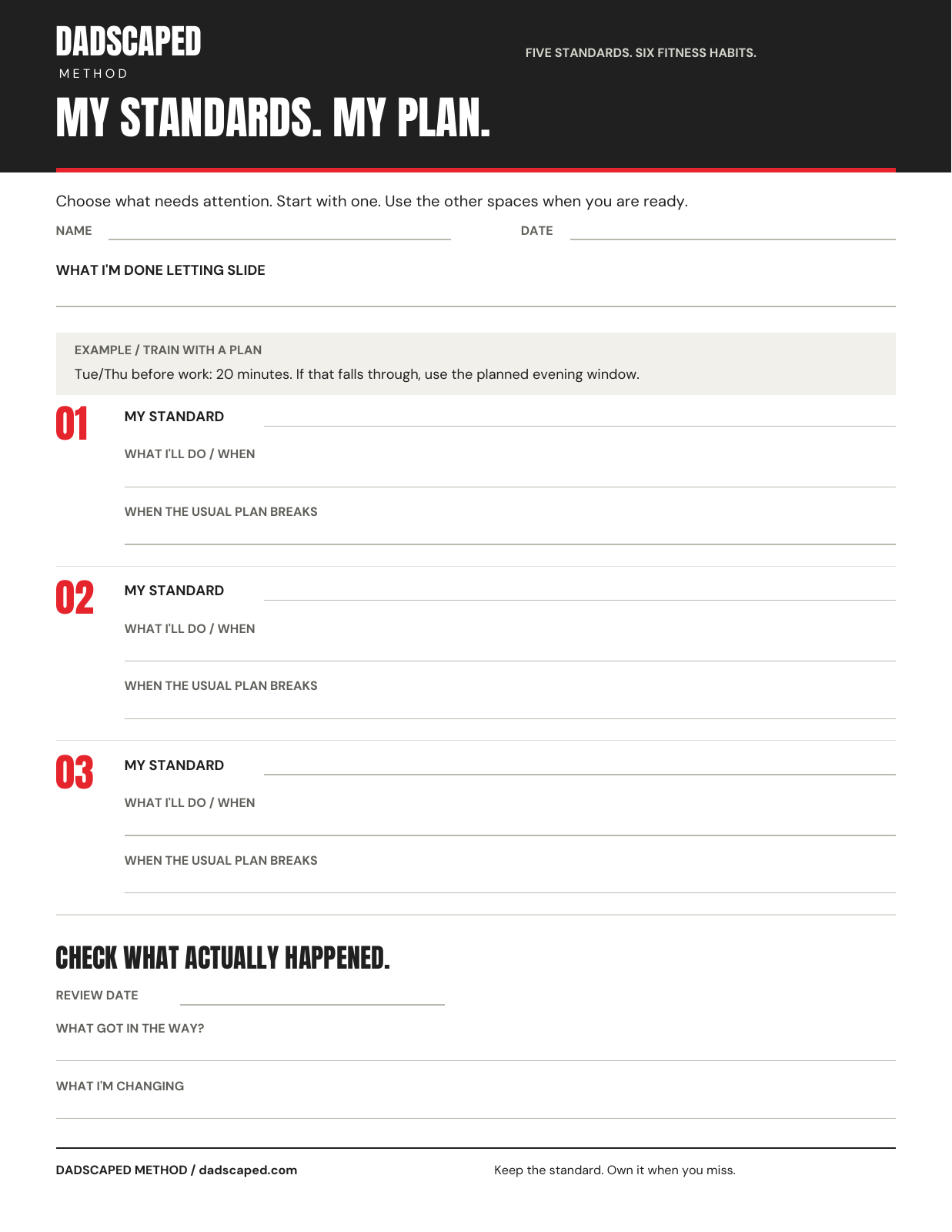
What are your hills to die on?
Decide what you're done letting slide. Pick a standard, write what you'll do and when, then have an answer for the days that don't go to plan. Start with one. Use the other spaces when you're ready.
Get fitter without making fitness your whole life.
If you want to get fitter but keep swinging between going all in and doing nothing, I can help you build a plan that fits your actual week. The DADSCAPED Method combines training, practical nutrition, and honest check-ins with feedback and adjustments when something isn't working. We account for your work, equipment, and family life so you have a clear next step you can actually follow.
Apply to work with meSources for the training and food notes
ACSM resistance training guidance (2026) supports the effort guidance; training to failure is not required on every set. Protein-rich yogurt snack research and research on snacks and fullness inform the food examples. Filling does not mean calorie-free, and responses vary.